Showing posts with label Collection. Show all posts

Friday, April 5, 2013

The Gowns of Goodwood

Gowns of Goodwood
The Art of Dressing
Fashions from 1830-1930
Julia Stevens Croom (born 1815), sister-in-law of the first
family of Goodwood, Bryan & Eveline Croom.
Goodwood Museum & Gardens is fortunate to be the repository of over 150 years of fashionable gowns.  From 1837 to 1990, five families have lived at Goodwood and their gowns are represented in this exhibition.  The exhibition traces fashion styles that span important eras in American History:  the Romantic Era, the Civil War Era, the Gilded Age, the Edwardian Era, the Civil War Era, the Gilded Age, the Edwardian Era, the Great War Period, the Roaring Twenties and the Great Depression Era.  

Like all art, fashion represents time and place.  The social and political changes in our country's past are reflected in the evolution of the gowns and accessories shown in the exhibition.  The viewer will note that fashion styles changed radically over these 100 years.

In the late 19th century, industrialization brought profound changes to the fashion industry.  Mass production of garments became the norm and department stores sprang up across America, giving access to lower-priced garments for ladies.

As you view the exhibit, note the influence of industrialization on style and design.  Buttons are replaced by zippers; cotton and silk are replaced by rayon.  Designers fashioned free flowing unencumbered gowns, freeing ladies of corsets and hoop skirts.  

Additional Resources:
Vintage Fashion Guild's "Fashion Time Line" from 1810-1970
Glamour Daze's Short History of Women's Fashion--1900 to 1969
American Textile History Museum
Chicago History Museum:  Costumes & Textiles

Thursday, April 4, 2013

Jergens Royal Perfume Violet

In our collection is a perfume bottle that once contained Jergens Royal Perfume Violet.  This bottle may have belonged to either Eva Hodges or Margaret Hodges.
J.J. Hodges, Eva Hodges, and William Cabot Hodges, early 1900s
Jergens founded in 1882 by Andrew Jergens of Cincinnati, Ohio. The company bought out Eastman Royal Perfumes in 1901. The company was purchased by American Brands in 1970.  Today the parent company of Jergens is Kao, founded in 1887 in Japan.  For a history of the company...
Mr. & Mrs. Andrew Jergens.  I bet she smelled sweet.
To see an 1918 advertisement for Royal Perfumes...

The Royal Perfume line was launched in 1910.  The company specialized in unique perfume names.  Other Jergens Perfumes from that year were Ponce de Leon, Pretty Pink Perfume, Queen of Hearts, Rose of Killarney, Scotch Thistle, St. Regis, Wild Grape Blossom, and Yutopia.

The Violet scent featured in a number of Jergens products:  Chloris Violet (1904), Panama Violet (1908), Normandy Violette (1918), Violet (1925), Violet Mt. Blanc (1925), Violette d'Orleans (1925), Violette de Lorme (1925, Violette de Saville (1925) and Violette Petals (1925).

Wednesday, April 3, 2013

Mellier's Honeysuckle

Eva M. (Parker) Hodges was born in Garden Plain, IL, 1853.
She was the mother of Sen. William Cabot Hodge.
She lived at Goodwood with her son and daughter-in-law
from 1925 until her death in 1939.
From the perfume bottle collection:  Mellier's Honeysuckle, New York, St. Louis.  This perfume probably belonged to Eva Hodges.

Mellier's was a pharmacy.  Very little information is available regarding the founder.  The pharmacy was bought out in 1892 by Maurice W. Alexander, who already had a highly successful pharmacy in St. Louis. Alexander's pharmacy had a line of colognes in the 1870s and it is possible that the line continued on under the Mellier name. The Honeysuckle fragrance was launched in 1899. For more on the use of Honeysuckle in perfumes...

Mellier's had a number of interesting perfumes including Dewey Bouquet (1898, named after Admiral Dewey), Florita (1899), Espanita (1900), Essence of Jamaica Ginger (1900), Tongaline (1900), American Beauty (1908), and Ping Pong (1910).  
Mellier's "High Class" Perfumes postcard

Tuesday, April 2, 2013

Old English Lavender by Yardley

Among the perfume bottles in our collection is Yardley's Old English Lavender.  This perfume likely belonged to either Margaret Hodges Hood or her mother-in-law, Eva Hodges.
Lavandula Augustifolia
Yardley is the world's oldest cosmetics company.  It was begun in 1770 and was a major producer of soap and cosmetics by the 20th century.  The perfume Old English Lavender was launched in 1813 and seems to have been discontinued by 1934.  Yardley is still known for their lavender fragrances.  The newer line, English Lavender, has been in production since 1873. While I can find no description of the Old English Lavender, other than "sweet and discrete", today's English Lavender line, considered Yardley's signature scent, combines "lavender leaves, neroli and clary sage with a heart of lavender oil and geranium, enhanced with deeper notes of tonka bean and sandalwood."  According to Yardley, the lavender they have used since the 1930s is Lavandula Augustifolia.  
1924
1931 French ad
"Partout avec l'Elegance"
Everywhere with Elegance

Monday, April 1, 2013

Bellogia Caron

Countdown for the Gowns of Goodwood exhibit (April 4-June 5).  This begins a series on the scents which graced the ladies who wore the gowns:

Based on the number of bottles in our collection, Bellodgia Caron appears to have been a favorite perfume of Margaret Hodges.  Formulated by the perfumer Ernest Daltroff, it first appeared on the market in 1927.  The inspiration for this perfume was the quaint Italian town of Bellagio, "The Pearl of Lake Como."  It is described as having top notes of carnation and rose; middle notes of jasmine, lily-of-the-valley and violet; base notes of musk, clove, vanilla and sandalwood.  Caron is now owned by the Ales Group and a reformulated version is still available for purchase (the bottle is unchanged after all these years).  The scent is described by Caron as "warm and lively... evocative of a field of carnations drenched in sunlight, punctuated here and there with roses, jasmine, violet, and lily of the valley... a shard of light stolen from the simmering Italian sun..."  Interestingly, this oriental perfume, inspired by an Italian town, was created by a Russian perfumer for a Parisian company and marketed to American women.
1926 advertisement for Bellodgia Caron perfume:
"latest creation of Caron of Paris"
1947 advertisement:  "Fleurs de Rocaille:
Bellodgia Parfume de Caron"
1960 advertisement, "subtly distinctive"

1961 Advertisement, "The Greatest Name in Perfume"
Caron Bellodgia

Friday, March 29, 2013

More Remedies & Recipes

More remedies* & recipes from the scrapbook.  This book appears to date from the late 1800s to the early 1900s and may have belonged to Clara Wilson, Margaret Hodges Hood's mother.  The Home Circle Magazine that many of the articles appear to have been clipped from was in circulation from about the 1850s until at least the 1930s.

*I do not recommend that anyone try these at home.

For Hoarseness
A flannel dipped in boiling water and sprinkled with turpentine and placed on the chest at beginning of cold or hoarseness will give relief.
For Disinfectant
Iodine is a poison and for external use only.  Diluted with an equal quantity of alcohol it makes an excellent disinfectant for wounds and sores.
For Cramps
For cramps in leg, wring a cloth out of hot water and rub well with toilet or laundry soap.  Tie around leg at knee and cover with another cloth.  Texas Girl, Brownfield, Texas.
For Tonsillitis
Dissolve two teaspoons of table salt in one glass of vinegar and use as a gargle for throat.  If vinegar is too strong, dilute with a little water. Use every fifteen or twenty minutes and gargle at least twice each time.  Sulphur is also very good to put in the throat after gargling.  A Sister, Lansing, Mich.
For Head Aches, Deafness, etc...
Will the sister who is troubled with head aches and others who are beginning to get deaf try this.  Five drops of tincture of iodine in a glass of lukewarm water to which one-half teaspoon of salt has been added.  Use as a gargle and to inhale through nostrils.  This is a cure for all nasal troubles, sore throats and colds.  For sore throats use as a gargle only.  If it causes a smarting sensation, too much salt has been used.  Edna O. Baker, Wales, Mass.
Sores on Mouth
Use polk berries as a wash.  Mrs. T.B McClure, Neola, Mo.
For Tired Eyes
Lay on eyes a cloth that has been wet in hot solution of boric acid water.
For Kidney Troubles
Make a strong tea of button willow and drink several times during the day.
For Bruise or Insect Bite
Mix clay with egg and vinegar to a paste, place on thin cloth and apply to injured part.  When poultice gets dry, moisten with vinegar.
For Ear-Ache
 Fill a medicine dropper with fresh warm milk and drop into affected ear.  Hold head to one side a minute, then throw back to opposite side.  Wrap head or put cotton in ear and lie down a few minutes.  Soon the buzzing sound and ear-ache will be gone.  Mrs. Harry Torrenga, Hebron, Ill.
How to Remove Ink from Woollens
Mrs. S.J., Guilford Co., N.C.--Please tell me how to remove ink from woolens.  Diluted acids do not injure the fiber so lemon juice, dilute oxalic or dilute hydrochloric acids may be used for ink and iron rusts.  
Furniture Polish
G.F., Putnam Co., Tenn.--Please give me a tried and true recipe for home-made furniture polish.  A very simple polish is made by mixing 1 part raw linseed oil with two parts turpentine and adding a little melted beeswax if desired.
To Remove Cataract of Eye*
Take fresh unsalted butter, melt and use just warm.  Lie on one side, the affected eye downward, let some one drop the melted butter into the upper most ear.  Lie still a few minutes until the oil has a chance to sink in. Begin with 3 drops first nigh, 4 drops second night, 5 drops the third night then miss 3 nights and continue for the next three nights, with 6-7-8 drops, again miss 3 nights, then go on with 9-10-11 drops.  If necessary to repeat performance, wait a week and then begin again.  It should be a sure cure.  In severe cases, it requires longer.
Red-Pepper Hash
15 medium-size onions; 24 sweet red peppers; 3 hot peppers; 2 small heads cabbage; 3 tablespoons salt; 2 tablespoons celery seed; 2 tablespoons white mustard seed; 1 1/2 cups sugar; 2 1/2 pints vinegar.  Remove seeds from peppers, and chop or run through grinder along with onions and cabbage.  Add other ingredients, mix well together, and heat until mixture boils.  Seal in sterile jars.  Miss L.H.

*This cataract remedy appears at least twice in the scrapbook.  I wonder if she ever tried it?  It sounds messy.  In another clipping, a reader asks:  "I am very anxious and have several friends who also wish to see repeated that old-time remedy for eye-film or cataract--the one containing unsalted butter I mean, especially, but shall be most grateful for any aid in overcoming this complaint.  Will you not do this?  I shall be most grateful, and will be careful not to lose the precious paper containing the reproduction as I did this one.  Sister Helena.  Altoona, Pennsylvania."

Wednesday, March 27, 2013

Remedies & Recipes

We have in our collection a fabulous scrapbook with all kinds of newspaper clippings mostly pertaining to remedies and recipies.  This could have belonged Margaret Hodges' mother, Clara Idella Wilson (1832-1945).   Some of the clippings come from Home Circle Magazine, which was in print from the 1850s until at least the 1930s.   A few eno means do I endorse trying them out.  Brace yourself for a few posts on this scrapbook.  I am completely fascinated!  A few examples* follow, all from the first two pages of the book.  

*I share these remedies out of historical interest and by no means do I endorse trying them out.  

For Diptheria
Roast an onion with sulphur in it, squeeze out juice, give the juice, bind onion on the throat and give sage tea made into syrup with honey and give honey and salts often.  I would like letters as I am lonely, my husband died three years ago and I live with my two boys on a small farm.  I wish those who are successful with chickens would write:  Mrs. Rettie Garman, Cork, KY
For Cataract of the Eye & Asthma
Dear Mrs. Helm:  Here are two simple and harmless remedies for cataract of the eye.  The Mexican remedy is put a drop of the milk from the cocoanut in the eye.  It cuts the cataract.  The other is 1 drop of honey three times a day, and that also cuts the cataract.  Will you please publish these, as I see by the magazine some one is looking for a remedy.  Wild plum bark, made into a tea and drinking three cups a day will cure asthma.  Take it for 6 weeks.  Mrs. H. Heide, San Francisco, Cal.
Seed Beer
One-half cupful of pearl barley and one-half cup of molasses or dark brown sugar to each part water.  Put these into a jar and cork tightly.  Set in a warm place for twenty-four hours and it will be ready for use.  The seed multiply rapidly.  After the seed are formed you need only the syrup and water to make a new supply.  It should be strained before drinking.
For Tonsillitis
Here is a sure cure for tonsillitis.  I was given up and went to an Herb Doctor who gave me a handful of Sage and some Sumach Berries.  I made a strong tea of these and gargled the throat with it, making two teas and using one an hour after the other.  After using this 10 hours, bathe the throat with Sassafrass Oil to take the swelling down.  I have told several about it, and they laughed and through it foolish but it did work.  Writes J.E.G., Redlands, Calif.
For Hair-Restorer
Here is a formula for hair-restorer which has been used for more than fifty years.  Three ounces each of glycerine and bay-rum, one-half ounce of lac sulphur, five drops of bergamot and one quart of boiled water.  Use as a hair-dressing every day until the hair is restored to former color, and then about twice a week.  This is not a dye, but restores the hair to the original color, and used as directed will keep it that way.  Mrs. L.N., Maiden, Missouri.
For Warts
To Sister Mollie, who asked about those willow-ashes for warts, let me offer another simple remedy which I have proved good.  I had a wart the size of a dime on my thumb and every time I bumped it against something, or played the piano, or did typing it hurt so that I wanted to cry.  I tried everything I could learn of to no avail.  I tried every doctor who put nitric acid on it, and all used the electric needle, but it just wouldn't go away.  Finally, in accordance with my aunt's suggestion, I cut a hole in a lemon and would put my thumb in every few minutes for a few days.  In a week the wart disappeared and has never returned:  this was nearly two years ago.  If the wart is where you cannot treat it in just this way, cut a piece of lemon, apply to the wart and tie up for two or three nights, or until the cure is effected.  Mrs. E.H.B., Omaha, Neb.
For Corns
Have any of you ever suffered with corns on, or between toes, a good relief for that is to make a grease with salicylic acid, and apply twice a day on the corn until you kill it, then it will come off when you soak your feet.  Miss Amelia Vidrine, Ville Platte, Louisiana.
For Rheumatism of the Bone
Dear Mrs. Helm:  I have read Home Circle for years and find the Homemakers Club the best ever.  I want to pass on a tried and true remedy for rheumatism of the bone.  My husband suffered for years with his right arm and is as free of pain now as ever, due to this remedy alone.  Dig a large polk root and wash, put in the stove and bake till soft.  Cut it open down one side and mash the inside until it is smooth and soft.  Then bind to the palm (inside) of the hand where the pain is in the arm; this will draw very hard and soon relieve the most severe case of rheumatism in a short time.  If the pain is in the leg apply the same poultice to the bottom of the foot.  Mrs. Melvina Presnell, Matney, North Carolina.
Grandmother's Ginger Cookies
One-half cup shortening; 1 cup brown sugar; 1 teaspoon salt; 1 cup molasses; 1 teaspoon ginger; 1 egg, 1 teaspoon soda; 1 cup sour milk; 4 1/2 cups pastry flour.  Cream shortening, sugar and salt.  Add other ingredients in order given with soda dissolved in sour milk.  Mix thoroughly; drop by spoonfuls on baking pan and bake in a medium oven. (50 cookies). 
Crisps Butter Cookies
1 cup butter; 1 cup granulated sugar; 2 eggs; 1 teaspoon Watkins Cream of Tartar; 2 1/4 cups flour; 1/2 teaspoon soda; 1/2 teaspoon Watkins Vanilla; 1/2 teaspoon Watkins Lemon Extract 

Wednesday, March 13, 2013

Political Craftsman in the White House

Yesterday, we made an interesting find while cataloguing books.  Tucked inside an autographed 1939 copy of Collected Poems of Robert Frost, was article about Robert Frost clipped from the New York Times Magazine dated January 15, 1961.  The backside of the clipped article is also interesting.  It is the beginning of an article on John F. Kennedy by Pulitzer Prize winner, James MacGregor Burns. The biographical note on Burns included in the article reads:  "James MacGregor Burns, a member of the political science department at Williams, wrote 'John Kennedy:  A Political Profile.'"

POLITICAL CRAFTSMAN IN THE WHITE HOUSE
Mr. Kennedy, it is suggested, has both the talent and the inclination for Presidential politics--and he will need them to sustain continuous leadership in the years lying ahead.

By JAMES MacGREGOR BURNS

In the long sweep of history the decisive mark of the man entering the White House Friday will not be his age, or his religion, or his Senatorial background, or the other matters so much discussed this past year.  What is vital is that once again America will have a political craftsman as President.

Born of a political family in one of the most political cities, Mr. Kennedy has spent all his adult life, aside from the war years, in the scuffle of legislative and electoral combat.  The key difference between the outgoing and incoming President is that Dwight D. Eisenhower dislikes this kind of politics and that John F. Kennedy consideres it indispensable to the operation of a great democracy, even inevitable.  "No President," he says, "can escape politics."

The great test of Mr. Kennedy's Presidency will be the test he himself would be the first to apply:  not whether he will be a politician--he will--but what kind of politician he will be and whether  his kind of political craftmanship will be enough for the staggering job ahead.  What are the prospects?  The answer turns on the nature of the Presidential office and not on the nature of the man.

Most of the time the Presidency is not a command post from which clear and concerted orders are issued to troops waiting to spring into action.  Most of the time it is a fulcrum of maneuver and bargaining, with the President seeking to convert a limited amount of power into governmental action.  It is a place where he must deal with hundreds of other powerful men in the outside the Government with their separate sources of power.  Most of the time the Presidency calls less for a master leader than for a master broker.

By experience and by temperament, Mr. Kennedy should qualify as a master broker.  The Boston brand of politics in which he was schooled is a kind of institute of advanced training in political manipulation.  For fourteen years in the Congressional labyrinth he has learned to negotiate with pround legislative leaders and party factions.  In two hears of pre-convention delegate hunting, he had ot bargain with state officials and city bosses whose political interests were far different from those of a junior Senator on the make.

Like a good poker player, a master broker must be cool-headed and clear-minded, utterly realistic about his own hand and that of his opponents, unflustered and unwilling to be hurried.  These, again, are keynotes of the President-elect's political style.  Observers have noted again and again his detached attitute toward himself, his cold insight into the balance of power, and his capacity to move quickly or slowly as conditions demanded.  His Cabinet-making was a case in point.  Despite pressure to hurry on with the job, he took his time as he sorted and measured and cut to fit.

Skill in bargaining is vital not only in negotiation with foot-dragging Congressmen and Governors.  A President must also bargain with Cabinet members and agency heads "supposedly" under him.  "I sit here all day trying to persuade people to do the things they ought to have sense enough to do without my persuading them," said Harry S. Truman.  "That is all the powers of the President amount to."

A new President soon finds that the neat lines of authority on the organization chart are actually snarled and broken by the political tempests that rage around the White House.  

"When it comes to power," says Prof. Richard E. Neustadt of Columbia, a former Truman aide, "nobody is expert but the President;  if he, too, acts as layman, it goes hard with him."  Mr. Kennedy can be reated as a professional in the care and nourishment of political power.  A President, he said to a visitor recently, must be careful not to use up his credit too quickly.  He nees the best people around him, but in the end he must depend on himself.  And, he added, he has only four years to make good.

To be effective, a master broker must operate at the center of the political cobweb.  (and here our portion ends...)

Monday, March 11, 2013

Paris at Dawn

From one of Hodges' scrapbooks, with the inscription "after years of World wandering I paste this in my book.  WCH.  1923."  The author of this poem is unknown.

Paris at Dawn

Paris at dawn; Egypt beneath the stars;
And spring in Tuscany!
Where, through ruined temples of old avatars,
The young moon peers,
White with the silver of forgotten tears;
Still, down the years,
New Aprils move eternally,
In rhapsodies of almond bloom.
And poets loved this beauty, too,
Who walked the secret way they knew.
Down to a shadowy tomb.

And other splendors--on the sea,
Set like a jewel--Sicily,
Crown with the light of Etna.  On her breast,
Her ruins like a decoration, rest.
Marbles of Greece, that knew immortal hours;
Gardens of far Japan, steeped in a wine of flowers;
Faint temple bells, the nightingale,
And palace, mosque, and minaret;
The burning stars upon a desert trail--
An ancient symbol--lest our hearts forget.

After all splendors--if the South--
My South, still knows
And gives some word of beauty for a sign;
The waxen marvel of camellias, white and rose;
A wide-winged heron's cloudy flight;
A thrush's mouth,
Brimming with starry music, through a night
Where pine-tree shadows stir,
And lily-troubled waters shine--
I shall return!  Ah, not to call it lovelier--
This land--than all the rest
My pilgrim feet have pressed,
But only that these things are mine--are wholly mine!

Thursday, March 7, 2013

On His Record of Service

A paid political advertisement from one of Senator Hodges' scrapbooks from March 1936:

On His Record of Service
Not a Platform of Promises
We Recommend
Senator Wm. C. Hodges
for Governor of Florida

Of Carolina parentage, schooled in Jeffersonian Democracy.  For 20 years member of the Florida Legislature.  President of the Senate the last term.
  1. Twenty years ago Senator Hodges introduced the first bill to exempt homes from taxation.  The bill received two votes.  But he carried the fight on continuously, and in 1934 the people exempted the homes.
  2. Twenty years ago he began the fight for pensions for the aged, dependent mothers and crippled children.  Today all America demands pensions for the aged.
  3. At every session of the Legislature Senator Hodges has labored for a nine-months term for schools and prompt payment of teachers' salaries.  He had passed the Senatorial Scholarship Bill.
  4. He has successfully opposed every form of sales tax unless all ad valorem was removed from real estate, and has assisted in defeating the nuisance taxes on the theory that grits and bacon of the poor should not be taxed for government.
Senator Hodges by his experience, his sound judgement and leadership is the man who has a record for a platform, not a platform of promises.
(Paid political advertisement of friends of Wm. C. Hodges)

Friday, February 22, 2013

Margaret in the Garden, 1962

Kodachrome prints of Margaret Hodges Hood in front of Gray Cottage.  This Camellia is now nearly double the size.


Wednesday, February 20, 2013

Missouri or A Voice from the South

Harry Macarthy
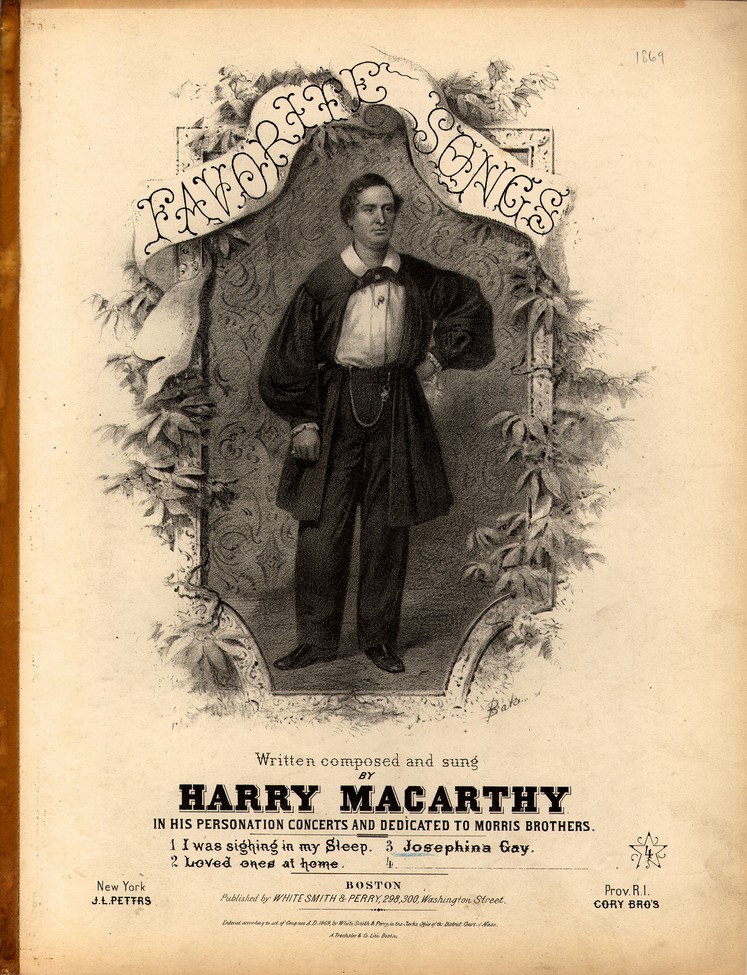
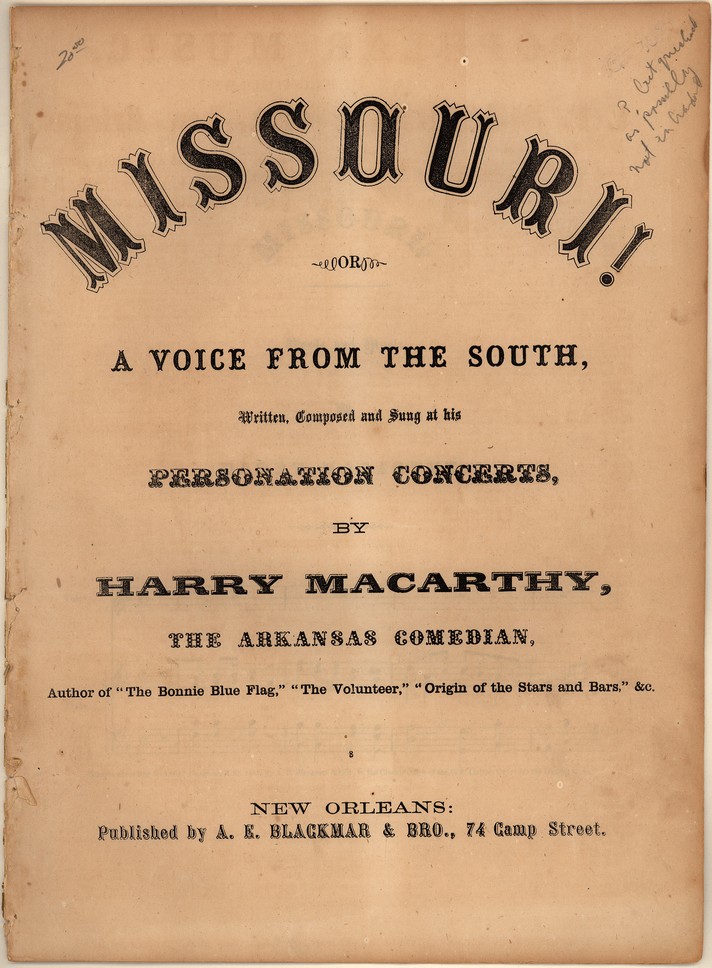
From the sheet music collection of Susan Hopkins:  "Missouri or A Voice from the South" by Harry Macarthy.  Given that I cannot find the tune online, we will have to make do with the sheet music here.  For more on Harry Macarthy, there is an interesting article at history.net entitled, "Harry Macarthy:  The Bob Hope of the Confederacy".  The Missouri History Museum has an entire website devoted to the civil war in Missouri
Sheet music from Library of Congress
Missouri, A Voice from the South
Missouri!  Missouri!  bright land of the West,
Where the way-worn emigrant always found rest,
Who gave to the farmer reward for the toil,
Expended in breaking and turning the soil;
Awake to the notes of the bugle and drum!
Awake from your peace, for the tyrant hath come;
And swear by your honor that your chains shall be riven,
And add your bright Star to our Flag of Eleven.

They'd force you to join in their unholy fight,
With fire and with sword, with power and with might,
'Gainst Fathers and Brothers, and kindred near,
'Gainst women and children, and all you hold dear;
They've o'errun your soil, insulted your press,
Murdered your citizens, shown no redress:
So swear by your honor that your chains shall be riven,
And add your bright Star to our Flag of Eleven.

Missouri!  Missouri!  where is thy proud fame!
Free land of the West, they once cherished name?
Trod in the dust by a tyrant's command,
Proclaiming there's martial law in the land.
Men of Missouri! strike without fear!
McCulloch, Jackson, and brave men are near;
Swear by your honor that your chains shall be riven,
And add your bright star to our Flag of eleven.

Tuesday, February 5, 2013

To Him Who Plants a Tree

From a Hodges' scrapbook, dated 1922.  Hodges wrote two notes on this page:  "one of the very best," and "This makes me think of my father who was always planting a tree--He died at 80 1/2 years--at peace with all the world."  His father was John J. Hodges (1842-1923).

TO HIM WHO PLANTS A TREE
Perhaps our God has somewhere made a thing
More beautiful to see
Than a majestic tree;
But if He has, I think it grows
In Heaven, by the stream that flows
Where whiter souls than ours do sing.

Who plants a tree, his is akin to God,
In this impatient age
Where quick returns engage
The fevered service of the crowd.
In reverent wisdom he is bowed
And hides his purpose in the clod.

The blessed man that plants a long-lived tree
That shall grow nobly on
When he is dead and gone,
He seems to me to love his kind
With true sincerity of mind,
He seems to love his fellows yet to be.

Above his grave the suns shall flush and fade,
The seasons come and go
And storms shall drive and blow;
But sun and rain that from his tomb
Efface his name, renew the bloom
And glory of the monument he made.
--Author Unknown
The Goodwood drive, lined by "long-lived trees" that "grow nobly on"

Friday, February 1, 2013

Hearts and Flowers Dinner for Two

From Margaret's February, 1951, edition of Home Gardening Magazine:


HEARTS AND FLOWERS DINNER FOR TWO
Fancy for February and Valentine's Day... A Hearts and Flowers Dinner for two... the new bride and her groom! The table setting will look like one big Valentine... so get out your fanciest "wedding gift" china, your prettiest "trousseau" linens, arrange a fresh flower centerpiece, and add lighted candles. Now we have the frills... how about the food fun?

MENU
PINK GRAPEFRUIT APPETEASER             CITY CHICK             MILK GRAVY
FLUFFY RICE HEART WITH PIMIENTO ARROWS
TOSSED GREEN SALAD
LOVER'S KNOT ROLLS (packaged variety)
LEMON BUTTERED ASPARAGUS
CUPID'S HEART-Y STRAWBERRY BAVARIAN
DEMI-TASSE          MINTS

Start the meal off with this gay tangy appeteaser.  It'll click!

Pink Grapefruit Appeteaser

Cut pink grapefruit in half crosswise, remove core, and free meat from membrane by cutting around each section.  scallop edges of shells.  Now fill the center with canned green grapes, and garnish with maraschino cherry "hearts".

Now for City Chick... even a bride knows there isn't a smidgen of chicken in this "make-believe"--but that doesn't seem to affect its ever-growing popularity.  City Chick, bless it, is simply generous chunks of veal and pork placed alternately on a skewer to resemble a chicken drumstick.  No waste... all good eating!
City Chick

Have your butcher prepare city chick for you.  Allow two drumsticks for each serving--that'll mean four for your dinner for two.  Now roll each one in flour so that it is well-coated.  Melt 3 tablespoons of fat in a skillet, add the meat and season with salt and pepper.  Brown meat well, turning it so the browning is even.  When browned to suit your taste, add enough water to cover bottom of skillet.  Cover and simmer gently for about 45 minutes or until tender, adding more water if necessary.  Remove the "chicken" and serve at once.

Milk Gravy

The good browned flour, meat juices and fat that are left in the skillet make wonderful gravy.  Blend 1 tablespoon flour with the juices and stir until smooth.  Place over low heat and gradually add 1 cup milk, stirring until gravy is smooth and thickened. If you like a thinner gravy, add a little more milk. Season with salt and pepper. Serve spooned in the center of a heart of fluffy rice, pierced with a pimiento arrow.

Cupid cuts a few capers in the "party-like" dessert, which is quite simple to prepare.

Cupid's Heart'y Strawberry Bavarian

1 tablespoon unflavored gelatin
1/4 cup cold water
1/2 cup hot water
3/4 cup confectioners' sugar
1 cup crushed frozen strawberries
1 tablespoon lemon juice
1 cup heavy cream, whipped 
candy hearts
additional whole strawberries

Soften gelatin in cold water, dissolve in hot water. Chill until partially set. Beat until frothy. Add combined sugar, strawberries, and lemon juice; mix well. Fold in whipped cream. Chill in individual heart molds. Unmold at dessert time; garnish with additional berries, whipped cream "puffs" with a top-knot of candy hearts.

Au Revoir Til March
When A Southern Coffee Buffet ushers in the Spring Season!  Until then, remember, Hearts and Flowers are quite glamorous... but HEARTY food helps out a heap!

Erna Harris

Wednesday, January 30, 2013

The Maiden's Prayer

From Susan Hopkins' sheet music collection:  "The Maiden's Prayer" by Tekla Badarzewska, who was born in Warsaw and died there in 1861.  Of her 35 pieces, this was the most well known.

By Eric Tong in 2007.  He provides some background information:

And for a Florida version before 1996, with Chubby Wise on fiddle:

Sunday, January 27, 2013

Capital Solons Awarded Posts

From Hodges' Scrapbook, an article from 1933:
Senator W. C. Hodges
CAPITAL SOLONS AWARDED POSTS
REPRESENTATIVES, SENATOR HODGES ARE COMMITTEE CHAIRMEN
Leon's delegation, Curtis Waller and George Martin, drew choice positions in the list of house committee assignments, announced Tuesday by Speaker Thomasello.   
Waller was made chairman of the committee of constitutional amendments and a member of the rules committee, conceded to be one of the most powerful committees in the house, uniform laws, judiciary A, finance and taxation, banking and loans, and the new committee, canal and drainage.
Martin is on the aviation committee, appropriations, education "B", insurance, primary laws, state pensions, veterans affairs, and was made chairman of the committee on public health.
State Senator William C. Hodges of Tallahassee, representing the eight district, was assigned to four of the most important committees in the Upper House.  Hodges was made chairman of the appropriations committee, resuming the powerful position he once or twice before has held in this respect.  He also was assigned to the committees on constitutional amendments, building and loans, insurance and state institutions.

Saturday, January 19, 2013

Early Goodwood

ca. 1911,  before the Tiers renovation.
Detail of the porch ironwork
Side view of home before 1911 renovation.  This is the side which now has
the glassed in porch.  Where the Butler's Pantry is today appears to be a
closed in veranda.  Note the original square cupola.
Excerpts from Susan Hopkins' niece, Susan Bradford Eppes' diary, Through Some Eventful Years, published in 1926.

1860:  Mr. Hopkins was par excellence, the merchant prince of Tallahassee; his income was large and his heart was ever open to the call of any who wished assistance. He carried a stock of goods which in richness and elegance surpassed anything ever seen in Tallahassee before or since.His home "Goodwood" was a model of beauty and comfort and was the centre of all social activities.  Mrs. Hopkins was the youngest daughter of Governor John Branch and had been a belle in Washington society. She had a delightful voice and was an accomplished performer on the piano, the harp and the guitar. Her husband had a splendid baritone voice and the music they made was worth going far to hear.

1865:  Aunt Sue is giving a large party; "the gem of the season," we say, for everybody knows the entertainments at Goodwood are not quite equalled anywhere else. There is one thing about this particular party that I dread; uncle Arvah has invited General Foster and his family and the officers in his command. I see Uncle Arvah's side and he is right, but it will be painful to meet our conquerors. So far I have met only one and I cannot hope they will all be like him. To meet these blue-coats socially! Will I have the strength of mind to do it? Not much time for you my diary. It is not difficult to get a dress now, but there are a thousand and one things to get through before tonight. Aunt Sue likes to have help in arranging flowers in the different rooms and the table in the dining room, which she has already dressed, is a dream of beauty

I866:  Again I am at Goodwood. Uncle Arvah is having a card party and I was sent for; you see, he taught me to play whist and he says he is proud of his pupil. I have not played at a regular card party before but often Judge Love comes to Goodwood and we play, Aunt Sue and the Judge against Uncle Arvah and myself. This, however, is a large party. General and Mrs. Foster are coming and many others; we have put three tables in the library and in the double parlors several more are placed. We have dressed the whole of the first floor, and the dining room is a dream. The chandelier is an immense shell of bronze, in it are waterlilies of mother-of-pearl. Six arms of bronze curve upward from this shell with its fluted edges, lighting the room beautifully and bringing out the pearly, pink tints of the lilies. The chandelier is supported by a figure of Neptune holding his tripod. It is the handsomest I ever saw and Mr. Croom, the former owner, brought it from Italy. He also brought over an artist from Rome who frescoed the ceilings of this lovely home. The mantel-pieces are of Italian marble, and all this is not in the downstairs rooms, for show, but each room is fitted up in the same way. Uncle Arvah and Aunt Sue are the very ones to have this spacious mansion for they love to entertain and indulge in a princely hospitality, which all enjoy.

Tuesday, January 15, 2013

Bonny Jean

From the sheet music collection of Susan Hopkins:  "Bonny Jean."  Interestingly, Susan's sheet music credits Charles Osborne, whereas others credit John Roberts Thomas.  After some digging, I have found that Charles Osborne was an alias for John Roberts Thomas.  It was published in 1856.  To listen to the tune...
George Linley (1798-1865)
Bonny Jean
O! the summer morn is brightly glowing,
The wild birds wake their song;
And the streamlet, as it softly murmurs,
So gently glides along.
Where the sweet hedge rose is blowing;
In the woodlands green;
There I love to wander,
With my heart's true Queen,
My bonny, bonny, Jean!

Yet, 'tis not the rosy tint of summer,
Nor the song birds joyous lay
Nor the streamlet's soft and murm'ring music,
That makes my heart feel gay;
'Tis her smile that  beams upon me,
'Mid each flow'ry scene;
While I fondly wander
With my heart's true Queen,
My bonny, bonny, Jean!

Monday, January 14, 2013

To the Reflecting Mind

From a Hodges' scrapbook, along with this handwritten note, "Cut out by me many years ago but put in scrap book 1924."  The author is not credited, but search revealed him to be Walter Savage Landor (1775-1864), English writer and poet.
Death itself to the reflecting mind is less serious than marriage.  The older plant is cut down that the younger may have room to flourish; a few tears may drop into the loosened soil, and buds and blossoms spring over it.  Death is not even a blow; is not even a pulsation, but a pause.  But marriage unrolls the awful scroll of numberless generations.  Health, genius, honor, are the words inscribed on some; on others are disease, fatuity and infamy.
From Walter Savage Landor, A Biography by John Forster

Thursday, January 10, 2013

Hodges and Futch

c1933 article from one of W.C. Hodges' scrapbooks
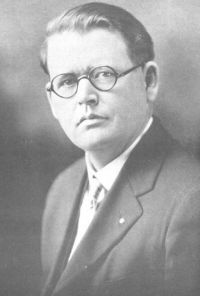
Truman Gaskins Futch (1891-1958) of Leesburg, District 23, was Florida Senate President 1933-1934. He served as state senator from 1929-1935 and was chairman of the senate educational committee.
T. G. Futch